
A strong trend in the Irish mortgage market in recent years has been the rise of “green mortgages” in Ireland. Lenders are increasingly rewarding borrowers who purchase energy‑efficient homes. They avail of fixed mortgage rates that can be more than 1% lower than standard rates. In addition, Bank of Ireland introduced its EcoSaver mortgage, which provides varying discounts depending on the Building Energy Rating (BER) of the property.
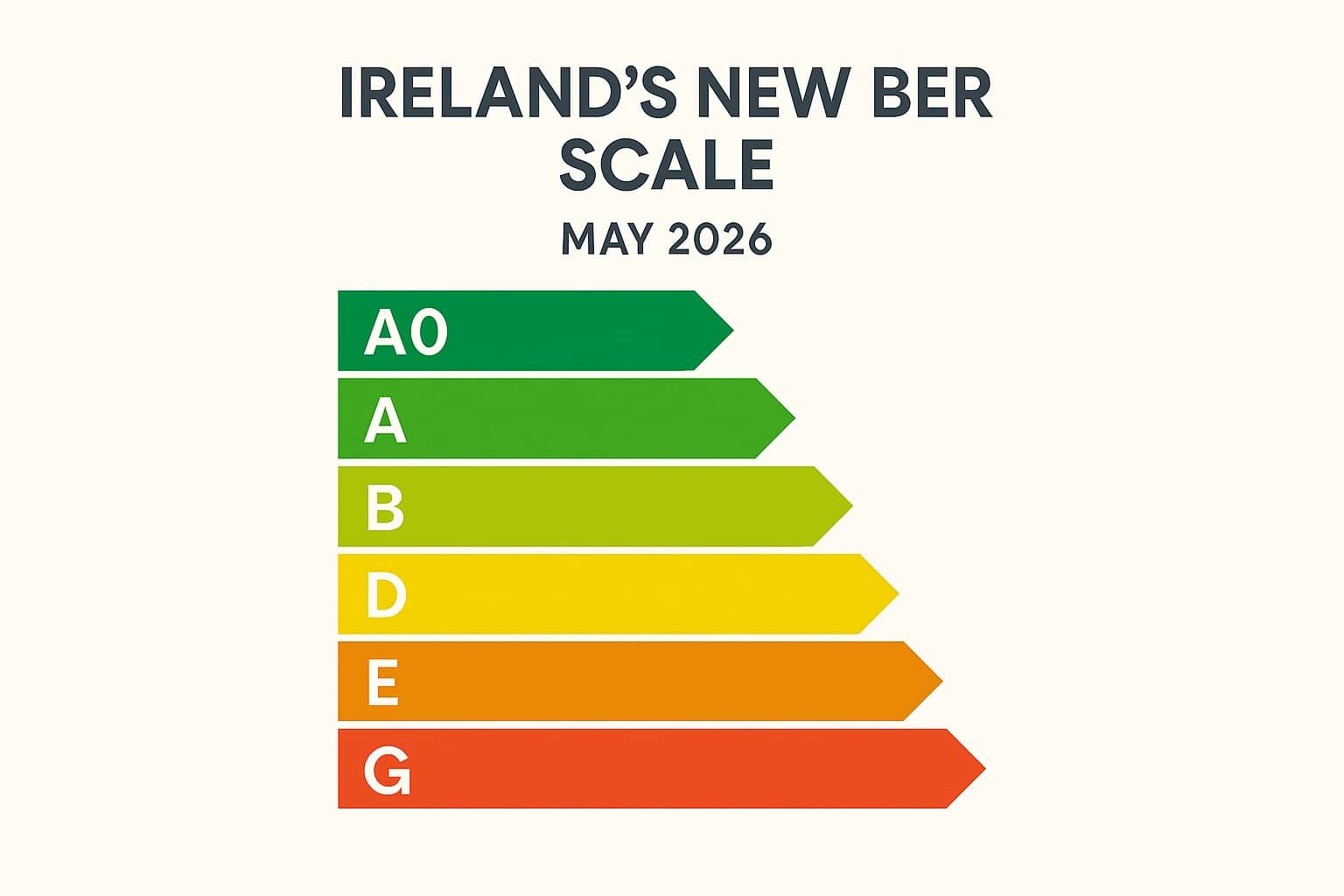
With energy efficiency now directly impacting borrowing costs, understanding your home’s BER rating in Ireland has never been more important.
New‑build homes are typically designed with high energy performance in mind, meaning they often achieve strong BER ratings. Older properties, however, may not meet these modern standards. This makes it especially important for homeowners and buyers to check their rating and understand where they stand.
Green Mortgage Options in Ireland
Most major lenders in Ireland now offer green mortgage rates to support buyers of energy‑efficient homes.
Banks such as AIB/Haven and PTSB provide discounted mortgage rates for properties that meet certain energy efficiency standards. Under the updated system introduced in May 2026, this typically means homes with a BER rating of A0, A or B qualify for these lower rates.
Bank of Ireland takes a slightly different approach through its EcoSaver mortgage. Rather than a single qualifying threshold, it applies a graded discount across all BER ratings, meaning every property can benefit, but the most energy‑efficient homes receive the best rates.
As a result, the better your BER rating, the greater the potential savings – making energy efficiency an increasingly important factor in both mortgage affordability and long‑term financial planning.
What is a BER? (Building Energy Rating Explained)
A Building Energy Rating (BER) measures the energy performance of a home and provides a simple way to compare properties. Much like the energy label on a household appliance, it shows how efficient a home is and helps buyers or tenants estimate likely energy costs.
In May 2026, an important update to the BER system in Ireland came into effect. The rating scale was simplified to make it easier to understand and more consistent across the EU. Instead of the previous 15‑point scale (A1 to G), the system now uses just eight ratings: A0, A, B, C, D, E, F and G.
Alongside this, a new top category – A0 BER rating was introduced. This rating applies to highly energy‑efficient, zero‑emissions homes that do not rely on fossil fuels, reflecting the future direction of housing in Ireland.
What is a Good BER Rating in Ireland?
In simple terms, homes at the top of the BER scale are the most desirable. A‑rated homes (including A0) are extremely energy efficient. They offer lower running costs and a higher likelihood of qualifying for the best green mortgage rates. B‑rated homes also perform well and are often included in green mortgage eligibility criteria.
As you move down the scale towards C, D and below, properties tend to be less efficient and more expensive to heat. With rising energy costs and sustainability becoming more important, both buyers and lenders are placing increasing value on higher BER ratings.
Do the 2026 BER Changes Affect Existing Certificates?
For most homeowners, the recent changes to the BER rating system won’t require any immediate action. Existing BER certificates remain valid for ten years from the date they were issued and can still be used when selling or renting a property. The new rating system only applies when a fresh BER assessment is carried out after 24 May 2026.
This means your current BER rating does not automatically change, even though the rating scale itself has been updated.
What’s New on a BER Certificate?
While the simplified scale is the most visible change, new BER certificates in Ireland now include more detailed and practical information. They provide insights into how your home uses energy, its reliance on renewable energy, and its overall carbon emissions. They also offer tailored recommendations on how to improve your rating.
In addition, each certificate now includes a QR code that links directly to further details and upgrade advice, making it easier for homeowners to take action.
How to Check Your BER Rating?
If you’re unsure of your BER rating, it’s easy to find out. The SEAI provides an online register where you can check your BER in Ireland using your property address or your MPRN number from your electricity bill.
If you’ve misplaced your BER certificate, you can still access your rating and advisory report online. You can request a full duplicate certificate from SEAI or from the original BER assessor who carried out the assessment.
Why BER Ratings Matter More Than Ever?
With the growth of green mortgages in Ireland, increasing energy costs, and a stronger focus on sustainability, BER ratings are now a key factor in the property market. A higher BER can help reduce your mortgage rate, lower your energy bills, and improve your home’s value.
The 2026 updates to the BER system are designed to make energy ratings clearer and more useful. However, they also highlight a bigger shift — energy efficiency is no longer just a technical detail, but a major influence on how homes are bought, sold, and financed in Ireland.
What if I lose my BER Certificate?
If you can’t find your BER Certificate and want to know what your BER rating is, you can click here to find your BER . Enter your BER number or MPRN number from your electricity bill or meter. You will then be provided with a copy of your BER and advisory report, not the actual certificate.
To get a duplicate copy of your BER Certificate, you can contact the SEAI on 1890 734 237. You can contact the original BER Assessor who provided it (their contact details are on the BER report).